
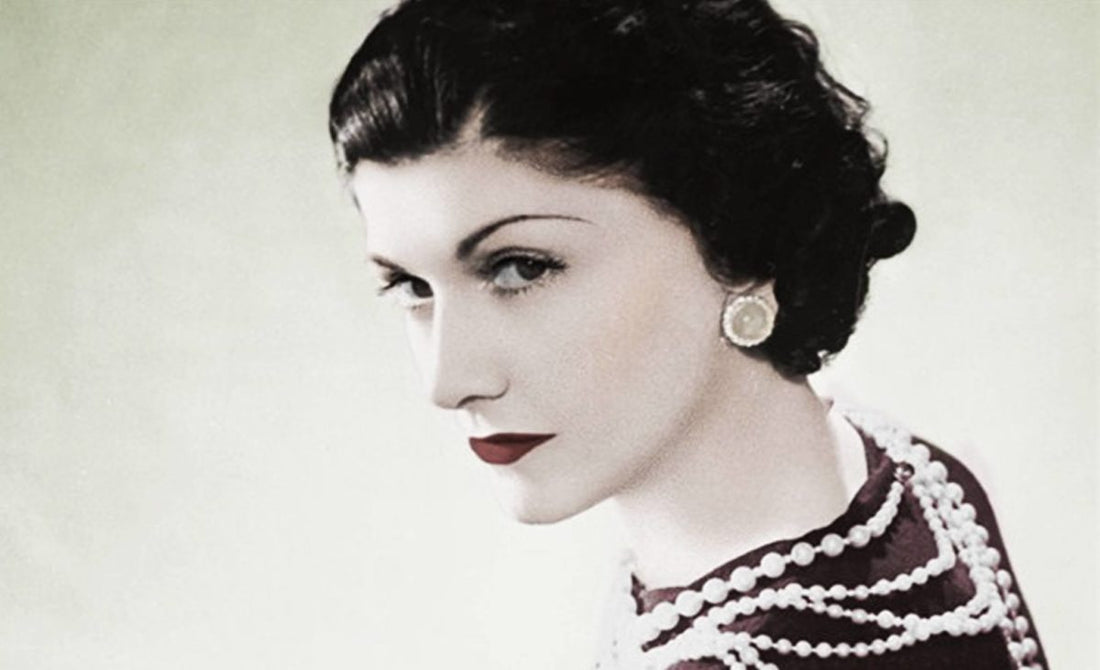

GABRIELLE “COCO” CHANEL 1883-1971


But it was in 1920 that her exclusive dedication to this aesthetic took place.
In that year Chanel opened her first boutique in Paris at 31 Rue de Cambon.
This was the crucial moment for the success of her career, seeing exponential and constant growth thanks to her ambition, which was defined by her incessant desire for more.
In 1921, Chanel launched her first fragrance, the iconic perfume that once belonged to the Tsar's perfumer, CHANEL N°5. It was the fifth fragrance presented to Mademoiselle Chanel and owes its name to this fact. A true timeless classic, CHANEL N°5 remains the absolute symbol of femininity.
The following year, CHANEL N°22 was launched. This floral fragrance, named after the year of its creation, is the offspring of the same revolutionary spirit that gave birth to CHANEL N°5 and is characterized by a unique blend of delicacy and audacity.
In 1924, the first makeup line was created. Chanel presented her first makeup collection, including lipsticks and powders. In the same year, "Société des Parfums Chanel" was founded, dedicated to the creation of unique fragrances and beauty products.
From this same incessant desire to create more, came the birth of her first and famous perfume, Chanel No.5, which can only be described as a timeless fragrance that, even today, is considered one of the best ever conceived. Subsequently, other fragrances were created, such as No.22, Gardenia, inspired by the designer's favorite flower, and No.19.


Always observant, Gabrielle Chanel used her observations of the clothing of Parisian employees and orders, characterized by black dresses with white collars and cuffs, to inspire her designs. In the mid-1920s, her analysis turned into the little robe noir, or the little black dress with the simplest possible lines, in the hope of making women equal to each other, albeit with immense style. True to her now firm conviction that "fashion fades, only style remains," this vision led to the absolute success achieved by the Chanel dress, loved by women all over the world: in gabardine, tweed, and, of course, jersey.
After establishing a substantial and consistent vision with her garments, the designer continued to focus her efforts on accessories. Chanel sought the help of Count Etienne de Beaumont and Duke Fulco di Verdura to start a workshop dedicated to costume jewelry creations, where non-precious gems were combined with the purest ones. Extremely rich and almost opulent creations were necessary for the designer, who loved the essentiality of her clothes and sought to perfectly balance them with extravagant accessories.
In February 1955, Gabrielle Chanel launched the iconic 2.55 quilted bag, named after the date of its creation. Combining leather and gold chains, Chanel invented a new and adaptable style of handle: at once durable and lightweight, it left hands free.

During World War II, Gabrielle Chanel was forced to withdraw from the fashion scene for a short period, only to return in 1954. Chanel, now at the age of 71, was considered by critics and colleagues to be on the verge of an imminent decline. Yet, in what is now an unsurprising turn of events, Chanel debuted her knitted suit, immediately transforming it into another staple of the house. Early fans of the classic suit included First Lady Jackie Kennedy who was often seen in these designs. Notably, on the day of her husband John F. Kennedy's assassination, she was wearing a Chanel suit with a bright pink knitted top.
On January 10, 1971, Chanel died in her suite at the Hôtel Ritz in Paris at the age of 87. Her life lived to the fullest, she forever changed international fashion and the concept of dressing the female body. Immediately after her death, the fashion house was led by Gaston Berthelot and Ramon Esparza, assistants to the late designer. It then passed to the creative direction of Karl Lagerfeld in 1983, an extraordinary designer who demonstrated how to make the house's stylistic codes contemporary without ever betraying Gabrielle Chanel's vision.